
When Public Records Become EvidenceA California Public Records Act Case Study: Daevon J. Taylor v. City of Los Angeles
- 2 days ago
- 12 min read
Updated: 1 day ago

Case Referenced: Daevon J. Taylor v. City of Los Angeles, LAPD, LADOT, LADWP, CAO
Case No.: 25STCP04097
Court: Superior Court of California, County of Los Angeles, Stanley Mosk Courthouse,
Department 82
Judicial Officer: Hon. Stephen I. Goorvitch
Petitioner: Daevon J. Taylor
Respondents: City of Los Angeles, LAPD, LADOT, LADWP, and CAO.
Records Are Not Just Paperwork. Records Are Evidence.
Public-records laws are supposed to give ordinary people a way to see what government agencies did, why they did it, who authorized it, and what records exist behind official action. But in real life, a California Public Records Act request can become a second fight: not just a fight over the original government action, but a fight to obtain the records needed to prove what happened. That is the center of Los Angeles Superior Court Case No. 25STCP04097, filed as Daevon J. Taylor v. City of Los Angeles, LAPD, LADOT, LADWP, CAO. The verified petition describes a CPRA writ action brought to compel Los Angeles city agencies to timely determine, search, segregate, and produce public records, and to justify any withholding with record-specific reasons identifying the responsible official.
This case study matters because it shows how public-records access can become essential when the same agencies holding the records are also involved in the underlying disputes. In that situation, delay is not just inconvenience. Delay can affect a person’s ability to identify decision makers, challenge official conduct, preserve claims, defend against charges, investigate vehicle impounds, and test whether agency records match what the agency later says in court.
The core message is simple: --- Records are not paperwork. Records are evidence.
What the Case Is About
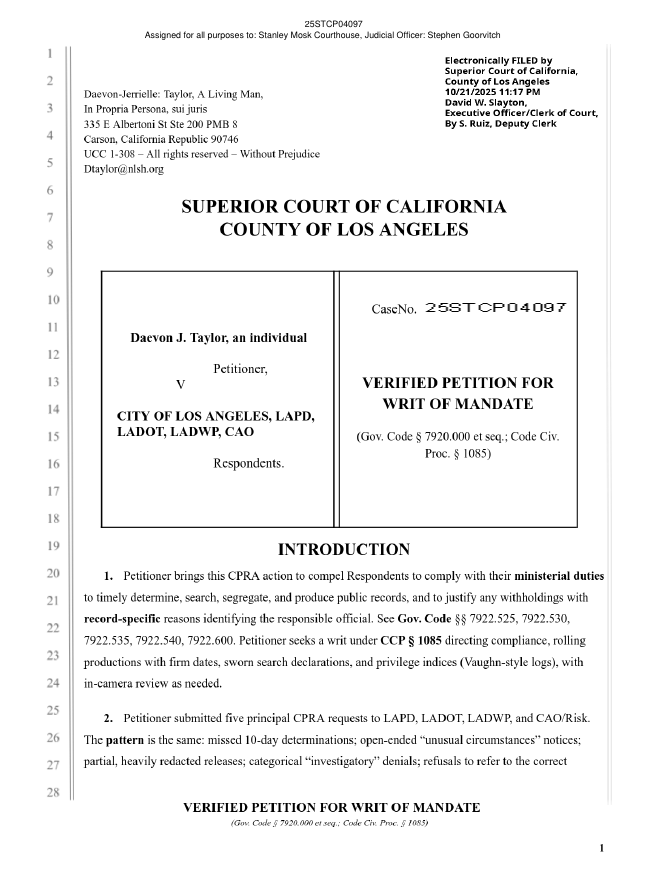
The petition in Case No. 25STCP04097 challenges alleged CPRA noncompliance by several Los Angeles agencies. The verified petition identifies the main public-records requests as involving LADOT Requests 25-11235 and 25-12498, LAPD Requests 25-11231, 25-12497, and 25-10166, CAO/Risk Request 25-13299, and LADWP Request R25-606.
The records sought were not abstract. They concerned vehicle towing and impound records, police search and seizure records, officer complaint materials, oath-of-office records, public-official bond or self-insurance records, and LADWP smart-grid / power-quality / utility-related records. According to the petition, those records were material to pending criminal, civil-rights, and government-claim matters. The opening trial brief frames the dispute as one involving prolonged delay, unsupported redactions, incomplete production, and repeated refusal by multiple city agencies to provide records central to Petitioner’s pending criminal, civil-rights, and administrative matters. The brief further states that Petitioner prepared a Schedule A to summarize each CPRA request, the agency response, and what records remained in dispute after the City’s partial productions.
The Procedural Background
On December 3, 2025, the Court held a trial-setting conference in Department 82. The minute order states that the City represented it would produce documents to Petitioner in response to his CPRA request within approximately 45 days. The Court set the hearing on the petition for May 8, 2026 at 9:30 a.m. and ordered the parties to make clear in the briefing what documents remained at issue given the City’s decision to produce certain documents. --- That order matters because the case was no longer just about whether requests had been made. It became about whether the later productions actually cured the alleged violations, whether important categories of records remained missing, and whether the City could clearly explain what existed, what did not exist, what was withheld, and why.
In Petitioner’s reply brief, the dispute was narrowed to the requests actually pleaded in the verified petition: LADOT Requests 25-11235 and 25-12498, LAPD Requests 25-11231, 25-12497, and 25-10166, CAO/Risk Request 25-13299, and LADWP Request R25-606. The reply argued that the City’s opposition did not show full compliance, especially because the City admitted continued searching for certain core LADOT records.
The CPRA Rules Readers Should Know
California’s Public Records Act is built on a broad rule of access. A “public record” includes any writing containing information relating to the conduct of the public’s business that is prepared, owned, used, or retained by a state or local agency, regardless of physical form or characteristics.
The word “writing” is also broad. It includes handwriting, typing, printing, photographing, photocopying, email, facsimile transmission, and other means of recording communication or representation, including words, pictures, sounds, symbols, or combinations of those items, regardless of how the record is stored. That means CPRA is not limited to formal paper files. Depending on the request, it can reach emails, logs, reports, dispatch records, photos, videos, electronic files, internal communications, databases, and records held in digital systems.
The CPRA also imposes timing duties. Government Code section 7922.535 requires an agency to determine within 10 days whether the request seeks disclosable public records in the agency’s possession and to notify the requester of that determination. If “unusual circumstances” justify more time, the agency may extend the determination deadline by written notice, but the extension may not exceed 14 days. The agency must also produce reasonably segregable nonexempt portions of records after deleting exempt material. In other words, if only part of a record is exempt, the agency generally cannot withhold the whole record without addressing whether nonexempt portions can be released.
When an agency denies a request in whole or in part, CPRA requires justification. Government Code section 7922.000 states that an agency must justify withholding by showing either that an express exemption applies or that, on the facts of the particular case, the public interest served by nondisclosure clearly outweighs the public interest served by disclosure.
CPRA also gives requesters an enforcement mechanism. Government Code section 7923.000 allows a person to bring a proceeding for injunctive or declaratory relief, or for a writ of mandate, to enforce the right to inspect or receive copies of public records.
For ordinary readers, the rule can be summarized this way: --- The agency must search, respond on time, produce nonexempt records, release segregable portions, explain any withholding, and help the requester identify responsive records.
What Petitioner Says Went Wrong
Petitioner’s theory is that the City’s responses followed a repeating pattern: missed deadlines, open-ended extensions, partial production, heavy redactions, broad exemption claims, referrals to other agencies or contractors, closures without complete search declarations, and lack of record-specific withholding explanations. The verified petition states that the pattern included missed 10-day determinations, open-ended “unusual circumstances” notices, partial heavily redacted releases, categorical investigatory denials, and closures without sworn search declarations or privilege indices.
The opening trial brief expands that point. It says Petitioner encountered blanket invocations of exemptions without record-specific justification, assertions that records do not exist without sworn search declarations, referrals to departments, contractors, or subpoena procedures instead of production, heavily redacted records concerning Petitioner himself, incomplete file sets, inaccessible or unusable digital files, and continuing “updates” or rolling responses after statutory deadlines expired.
The reply brief sharpened the issue: Respondents’ opposition, according to Petitioner, did not establish lawful compliance because it confirmed incomplete searches, shifting exemption theories, generic redaction claims, rerouting to subpoena practice or other custodians, and an inability to state precisely what records exist, what records do not exist, what records are withheld, and why.
LADOT: Tow Records, VIN Redactions, and OPG Materials
One of the clearest examples in the case involves LADOT tow and impound records. The Lisa Figueroa declaration states that LADOT Request No. 25-11235 sought tow authorization and violation records, personnel and oversight information, body-worn camera or video footage, communications, towing-company information, insurance policies or surety bonds, and reports or follow-up actions. The City’s opposition says LADOT produced certain records but redacted the VIN on citations and a CHP-180 form under Government Code section 7922.000, asserting privacy concerns even though the request concerned Petitioner’s own vehicle. The opposition also says some CHP-180 sections were unreadable or blank and that DOT produced the only version it possessed.
That point is important for readers because it shows how a redaction dispute can become an evidence dispute. If a requester is trying to verify whether a tow file actually matches his vehicle, his notice, and his impound event, a redacted VIN may prevent him from confirming the identity of the vehicle in the record. The City’s position is that disclosure to the public could increase risk of misuse. Petitioner’s position is that the agency still must make a case-specific showing and cannot rely on generic privacy language, especially where the requester is the subject of the records.
The City’s opposition also states that LADOT advised Petitioner to contact LAPD and the Official Police Garage for certain records because DOT claimed it did not actually or constructively possess those records. But the same opposition also acknowledges that for Request No. 25-12498, LADOT was still continuing to search for categories including CHP-180 forms, tow authorization and dispatch logs, post-storage notices, OPG tow file packets, post-storage hearing logs, returned-mail and vendor batch reports, and abandoned-vehicle / 72-hour enforcement policies. That creates the public-interest question at the heart of the case: --- Can an agency say it does not possess certain records, refer the requester elsewhere, and still admit that it is continuing to search for those same categories of records?
The Released Tow Records Show Why the Record Trail Matters
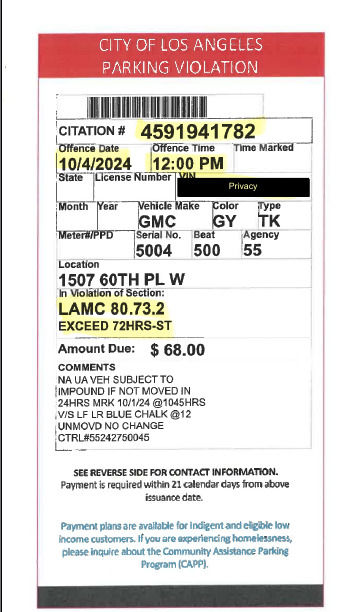
The GMC tow records released by the City illustrate the problem. The eTIMS abandoned vehicle report identifies Control No. 55 2024275 0045, shows a citation issued on October 4, 2024, and lists a ticket number appearing as 45919441702.

The actual City of Los Angeles parking citation, however, shows Citation No. 4591941782, while still referencing the same control number.
The CHP-180 tow form also appears incomplete in multiple sections, including several blank or unchecked areas and a largely blank second page. When compared with the Jeep records production, which includes a broader packet of eTIMS screenshots, ticket history, hearing logs, CHP-180 materials, citation records, notice documents, and a redaction log, the GMC release appears narrower and incomplete.
That comparison is central to the CPRA issue. The dispute is not whether some records were released. The issue is whether the released records were complete, internally consistent, and sufficient to allow the requester and the court to reconstruct what happened.
For readers, this is one of the most important lessons from the case. In a CPRA dispute, “we produced some records” is not the end of the analysis. The real question is whether the agency conducted a complete, reasonable, request-specific search and clearly identified what remains missing, withheld, redacted, or outside its possession.

LAPD: Search Records, Complaint Records, Oaths, and Investigatory Exemptions
The case also involves LAPD requests for search-and-seizure records, complaint-related records, and officer oath records. The City’s opposition identifies LAPD Request No. 25-11231 as seeking records, reports, video, audio, and associated materials related to a June 5, 2024 search and seizure, including search warrants and legal instruments, operation planning and oversight records, body-worn camera and surveillance footage, pre- and post-operation documentation, property and evidence records, communications, and accountability records. The City’s opposition says LAPD had back-and-forth exchanges with Petitioner, stated that some records had already been provided, stated that some categories did not exist after exhaustive searches, and withheld other records under Government Code sections 7927.705 and 7923.600, and Penal Code section 832.7(a).
For readers, the key educational point is that law-enforcement records can involve exemptions, but exemption language does not automatically end the inquiry. The agency still has to justify the withholding under CPRA’s rules. Government Code section 7922.000 requires the agency to justify withholding by pointing to an express exemption or proving that, on the facts of the particular case, nondisclosure clearly outweighs disclosure. Petitioner’s position is that broad law-enforcement and catch-all labels were used without enough record-by-record explanation, segregability analysis, or meaningful production of nonexempt material. The City’s position is that certain LAPD records were properly withheld because of official-information, investigatory, and peace-officer personnel-file concerns. That is the legal conflict readers should understand: CPRA does not say every police-related record is automatically public, but it also does not allow agencies to withhold records through vague labels without a proper statutory showing.
CAO/Risk: Public Bonds, Insurance, and Self-Insurance Records
The CAO/Risk request, identified as Request No. 25-13299, concerned records related to public-official bonds, indemnity agreements, insurance coverage, and later the City’s self-insurance or risk-management program. The City’s opposition states that Petitioner sought records related to individual or blanket public-official bonds, indemnity agreements, or insurance coverages for two LAPD officers, and that the CAO responded that the City uses a self-insurance / retention program for third-party liability claims. The City says searches by multiple departments yielded a 2023 actuarial report, which was produced on December 12, 2025, and that no additional responsive records were located.
This part of the case is useful for readers because it shows another common CPRA issue: when a requester asks for one category of records, and the agency says the records do not exist in that exact form, the duty to assist may require the agency to help identify the records that do exist. CPRA is supposed to help the public reach the actual public records that reflect the government’s conduct, not trap the requester in technical wording.
LADWP: Smart-Grid and Technical Records
The verified petition also identifies LADWP Request R25-606 as one of the pleaded CPRA requests. The petition describes it as seeking power-quality, smart-grid, and power-line-communication-related records. Petitioner alleged that LADWP acknowledged the request, asked clarifying questions, identified responsive records, and later postponed access without a complete written determination, partial production, or privilege index. For readers, this part of the case shows that CPRA is not limited to simple documents. Public records can include technical manuals, contracts, policies, communications, deployment materials, test data, vendor records, and other digital or technical files if they relate to the conduct of public business and are prepared, owned, used, or retained by the agency. The statute’s definition of “public records” is broad and applies regardless of physical form or characteristics.
The City’s Defense Position
The City’s opposition argues that this CPRA case involves multiple requests, but that only the requests pleaded in the petition are properly before the court. The opposition identifies the pleaded requests as LADOT Requests 25-11235 and 25-12498, CAO Request 25-13299, LAPD Requests 25-12497, 25-11231, and 25-10166, and LADWP Request R25-606. The City argues that departments conducted exhaustive searches, produced responsive records to the overwhelming majority of requests, redacted or withheld some records under state law because of privacy, security, or criminal-investigation concerns, and referred Petitioner to third parties where the City claimed it lacked control. The City also argued that CPRA does not require agencies to create records that do not exist or produce sworn declarations to verify that records have not been located, though the City filed declarations in support of its opposition.
That defense position is important to include because a strong case study should be fair: the City does not admit broad noncompliance. It claims substantial compliance, lawful redactions, proper exemptions, and limited remaining issues. Petitioner’s case study response is that the City’s own opposition confirms unresolved searches, missing core categories, generic redaction theories, and incomplete request-specific compliance.
Why This Case Matters Beyond One Person
This case matters because public records are often the first layer of accountability. A person cannot effectively challenge a vehicle impound without tow authorization records, dispatch logs, post-storage notices, mailing proofs, CHP-180 forms, and hearing records. A person cannot fully evaluate a police search without warrants, returns, inventories, body-worn camera footage, planning records, property records, and communications. A person cannot test an agency’s redaction or exemption claim without knowing what record is being withheld and why. -- In the public-access context, delay can operate like denial. A record produced months later may arrive after a deadline, after a hearing, after a claim period, after an impound dispute, or after a litigation opportunity has passed. That is why the phrase “records are evidence” is more than a slogan. It is the core public-interest issue.
The CPRA Lessons for Readers
First, requesters should identify the agency, date, event, location, case number, vehicle plate, citation number, officer name, or other anchors that help the agency search.
Second, requesters should track deadlines. CPRA generally requires a 10-day determination, with only a limited 14-day extension for unusual circumstances. Open-ended updates are not the same thing as a lawful determination.
Third, requesters should ask for segregable portions. If the agency claims part of a record is exempt, it should still release nonexempt portions unless the entire record is lawfully withheld.
Fourth, requesters should challenge generic withholding explanations. Under Government Code section 7922.000, the agency must justify withholding through an express exemption or a case-specific showing that nondisclosure clearly outweighs disclosure.
Fifth, requesters should build a “records remaining in dispute” schedule. That is exactly what the Court’s December 3, 2025 minute order required the parties to clarify: what documents were still at issue after the City’s partial productions.
Public Accountability Requires a Record Trail
The broader question in Daevon J. Taylor v. City of Los Angeles, LAPD, LADOT, LADWP, CAO, Case No. 25STCP04097, is not whether the City produced something. The question is whether the City produced what CPRA required, when CPRA required it, with the explanations CPRA demands, and in a way that allows the requester and the court to test whether the searches, redactions, referrals, and withholding decisions were lawful.
A public-records law has limited value if agencies can delay, redact, refer, fragment, and close requests without meaningful accountability. This case study shows why CPRA litigation sometimes becomes necessary: because access delayed can become access denied, especially when records are needed to defend rights in another courtroom. At the center of this case is a principle every reader should understand:
Follow the record. Follow the timeline. Follow the agency response. That is where accountability begins.
Document Archive
The following records are referenced in this case study and should be reviewed together as part of the public record trail:
GMC eTIMS Abandoned Vehicle Record Detail: Shows Control No. 55 2024275 0045, citation/impound timeline, violation code, officer IDs, and impound entry.
GMC City of Los Angeles Parking Violation Citation: Shows Citation No. 4591941782, offense date October 4, 2024, offense time 12:00 p.m., violation LAMC 80.73.2, and the same control number referenced in the eTIMS record.
GMC CHP-180 Vehicle Report: Shows the impound/tow form connected to the GMC event, including storage authority, tow company, location, and several incomplete or blank sections.
Jeep Records Production Packet: Used as a comparison record set showing a broader production packet, including eTIMS screenshots, ticket history, hearing documents, CHP-180 materials, citation records, notice documents, and a redaction log.
Verified Petition with Exhibits:
Opening Trial Brief:
Respondents Opposition to trial brief
Respondents’ declarations: Figueroa, Keir, Ng, Okafo, Wilson: These are useful because the City’s own declarations confirm request numbers, dates, agencies, and what they claim was searched or produced.
Petitioners Reply Brief
This case study is part of The Sovereign Record public-accountability series examining court records, public-records disputes, agency transparency, and the role of documentary evidence in civil-rights and due-process litigation.
Case: Daevon J. Taylor v. City of Los Angeles, LAPD, LADOT, LADWP, CAO
Case No.: 25STCP04097
Court: Los Angeles Superior Court, Stanley Mosk Courthouse, Department 82
Subject: California Public Records Act writ proceeding
Theme: Records are evidence. Access delayed can become access denied.

Comments